
More than language models: Why applied AI is the big opportunity for Europe. I was allowed to write something about this for t3n magazine.
Here is the link to the article (in German)
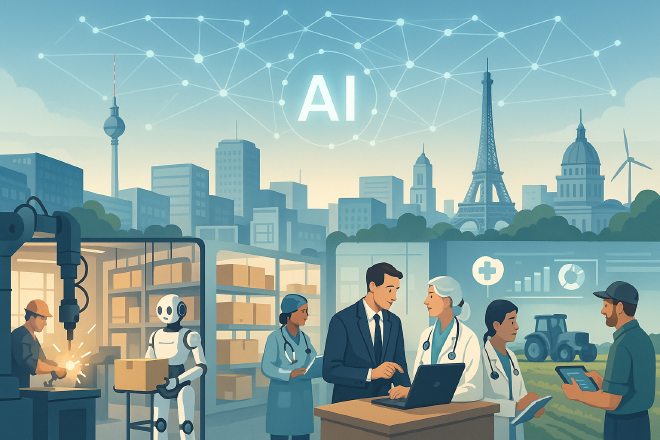
Europe’s AI revolution: the underestimated opportunity
“Europe has lost the AI race” - this is the hasty judgment of many experts. While the headlines focus on breakthroughs in large-scale language models, a fundamental shift is quietly taking place: the next phase of AI transformation is not only taking place in the data centers of AI developers, but in practical applications in companies. And this is precisely where Europe’s great opportunity lies.
A good example of this is Siemens, which is developing the first Industrial Foundation Model (IFM) together with Microsoft. This AI model, which specializes in industrial data, is intended to redesign collaboration between humans and machines and increase productivity in manufacturing - proof of how European companies are making AI usable for industrial applications in a targeted manner.
Value is created where AI meets decades of industrial experience and real business processes. Europe’s strengths lie in its highly innovative SMEs, leading technology companies and an outstanding research landscape. European companies and start-ups are developing AI solutions that may make fewer headlines than ChatGPT, but create tangible economic value.
The next wave of AI innovation
This transformation is already in full swing. The European focus on developing trustworthy AI systems that meet high European standards is helping here. The EU AI Act adopted in 2024 will create a binding legal framework for this for the first time, even if full implementation will still take years.
Enterprise AI: the digital transformation of business processes
A current example of this development is the strategic partnership between the French AI company Mistral, SAP and Capgemini. Together, they are developing customized AI solutions for highly regulated industries such as financial services, the public sector and the energy industry - areas in which Europe has traditionally been strong.
This collaboration illustrates Europe’s competitive advantage: the combination of technological innovation, industry expertise and regulatory know-how.
Vertical AI: Industry-specific AI solutions
Industry-specific AI expertise creates unique competitive advantages. What is often seen as Europe’s biggest hurdle - strict data protection and security standards - is becoming a strategic advantage: these standards force the development of trustworthy AI systems from the outset. A competence that could develop into an export hit in view of stricter regulation worldwide.
One example is the cooperation between Mindpeak and ZEISS in the field of medical image analysis. The start-up from Hamburg, which recently secured Series A funding of 15.3 million dollars, develops AI solutions that support pathologists in the precise diagnosis of diseases. The integration of its AI algorithms into ZEISS microscopy systems creates concrete added value in everyday clinical practice.
Industrial AI: Optimizing manufacturing
In contrast to consumer applications, where US companies dominate, Europe has a natural head start in the application of AI in the manufacturing industry thanks to its broad industrial base. In addition to Siemens with its Industrial Foundation Model, the Swedish startup iPercept is another good example. Their AI-based solution, which emerged from a multi-year research project between Swedish companies and the KTH Royal Institute of Technology, is a new method for automatic condition monitoring of metalworking machines during ongoing production. This innovation not only enables the early detection of wear, but also optimizes the service life of production equipment - a direct contribution to the efficiency and sustainability of industrial production.
Outlook
Europe’s AI future rests on three pillars:
Industrial strength: Decades of expertise in key industries
Technological innovation: Leading research and innovative start-ups
Regulatory expertise: Global pioneering role in AI standards
This combination creates unique conditions - if existing hurdles are consistently removed.
There are three key challenges in particular that need to be overcome:
Lack of scale: Fragmentation in the EU makes rapid growth difficult
Capital gap: European startups receive on average 1/3 less funding than US competitors
Regulatory uncertainty: Clear and uniform implementation guidelines for the AI Act are still lacking
A fully integrated digital single market with harmonized rules and common data spaces will become an important lever for Europe’s global AI competitiveness. The provision of more venture capital for AI start-ups and the expansion of initiatives such as the Leap Innovation Agency at European level are further decisive levers for Europe.
Europe must make rapid and consistent progress here. China has also recognized these opportunities. In April, the Party Politburo met for its second study session on AI (the first was held in 2018). At the meeting, President Xi Jinping said that China should focus even more on the application of AI.